


Owlet, Moon & Mother
Size: 37.25 x 21.25 x 2 inches
January
Lovebirds & 7 Planets Aligned
Size: 37.25 x 21.25 x 2 inches
February
Drollery Hare, Poppies & Susans
Size: 37.25 x 21.25 x 2 inches
April
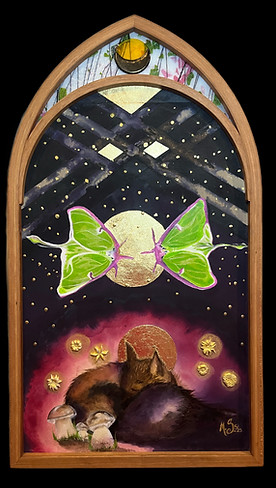
Luna Moths, Mushrooms & a Fox
Size: 37.25 x 21.25 x 2 inches
May

Every pigment carries stories of agriculture,
biodiversity chemistry, cultural exchange, medicine, migration, and trade - Maria
Bumblebee and Blooms
Size: 37.25 x 21.25 x 2 inches
June


Snowbursts, Crows, and Flying Squirrels,
32 x 20 x .5 inches, 12/2024.
Painting Recipe: laked oak gall, yellow cosmos, yellow onion skin, yellow yarrow and white tempera on cold press watercolor paper mounted to wood panel.
Applied Materials: clay, a fused-glass crown, a cherrywood overlay frame, and gold leaf.
Description:
Sweeping in like the darkness of night a landing crow, winds unfurling all those with wings, the dragonfly powdered in edible gold, with a setting winter sun behind. Divinity lines run the boarder of the piece acting as a sacred container and Irish woven pattern tieing the piece into a spell bound golden thread. Whimsical, magical age of high middle ages brings in letters and lines of the divine, a deep slumber winter, blankets of ice line the homes in the deep Midwest winter night.
Photograph: Environmental conditions:
Location:
39.12426° N
86.54326° W
Moon Phase: Waning Crescent Moon
Animal: Crow
Species: The Northern flying squirrel, Glaucomys sabrinus coloratus, is a species that is currently listed on the Endangered Species list.
Represents: December


Owlet, Moon & Mother,
32 x 20 x .5 inches, 01/2025.
Painting Recipe: laked mulberry, yellow cosmos and eucalyptus dye, laked oak gall, and white tempera on cold press watercolor paper mounted to wood panel.
Applied Materials: chalk, clay, fused glass crown, and cherrywood overlay a
custom-designed rose symbol, printed on vellum paper and applied as a textural background that references the historical and cultural significance of the rose.
Description:
Gazing in opposite directions, symbolizing the evolving relationship between protection and independence, where mother and child gradually exchange perspectives.
A custom-designed rose, printed on vellum, creates a textured ground, carrying the flower’s cultural memory. During the High Middle Ages (11th–13th centuries), the rose evolved from a symbol of Roman luxury into one of Europe’s most cherished religious and cultural emblems. Gold leaf captures the radiance of life, while insects symbolize nourishment, interdependence, and the sacred cycles connecting all living things.
Photograph: Environmental conditions:
location:
39.13653° N,
86.56126° W
Moon Phase: Full
Animal: Owl
Species: Several owl species around the world are currently classified as endangered, critically endangered, or threatened, mainly due to habitat destruction, invasive species, climate change, and human activity.
Represents: January

Lovebirds and 7 Planets Aligned
32 x 20 x .5 inches, 02/2025.
Painting Recipe: laked chokecherry, daffodil, mulberry, oak gall, pokeberry, and white tempera on cold press watercolor paper mounted to wood panel.
Applied Materials: chalk, clay, a fused glass crown, and a cherrywood overlay frame. The composition incorporates preserved botanical elements, finished with a layer of gold leaf.
Description:
The unusual teal pigment was created using laked pigments derived from false indigo and daffodil. Above the lovebirds, a flower playfully drapes over their heads, bringing a sense of playfulness to the composition. Textural squares of edible gold, applied through a mold-printing process, introduce a tactile, luminous surface. Delicate lines of divinity draw attention to the sacred heart, celebrating the interconnected divinity of life and the enduring power of love.
Photograph: Environmental conditions:
location:
39.08165° N,
86.43373° W
Star Phase: waning crescent moon
Animal: Lovebirds
Species: There are currently 460 bird species classified as endangered by the International Union for Conservation of Nature (IUCN). These species face a very high risk of extinction in the wild due to various threats, including habitat loss and human activities.
Represents: February




Turtle, Snails & Strawberries,
32 x 20 x .5 inches, 03/2026.
Painting Recipe: laked avocado seeds and skins, processed goldenrod, laked indigo, ironweed, madder root, lac, strawberries, yellow marigolds, and yellow yarrow on cold press watercolor paper mounted to wood panel.
Applied Materials: clay, edible gold, gold leaf, glass crown created using a fusion method, frame: cherrywood layover, and mica minerals.
Description:
Divinity lines of gold leaf trace the sky across this piece, the only work in the collection to chart the constellation Kassiopeia. She is spelled with a K in honor of the artist’s German ancestry, a small letter that carries a lineage.
In medieval Europe, the creatures of the shell were creatures of meaning. The snail wandered the margins of illuminated manuscripts, where it famously faced down armored knights in comic, tiny battles. Here, the shells return as sanctuary: protection, enclosure, and refuge, a small home carried through the world and a quiet shelter beneath the stars.
Folk: The turtle is sacred in many Indigenous traditions, but its meaning varies by nation. Haudenosaunee (Iroquois) tradition: The Great Turtle is central to the Sky Woman creation story. After Sky Woman falls from the sky world, animals help her, and land is placed on the back of a giant turtle. This is one origin of the name Turtle Island.
Photograph: Environmental conditions:
Location: 39.1187411° N
86.59003°W
Moon Phase:
Animal: Turtle
Species: Many turtle and tortoise species are heavily endangered. Over half of all freshwater turtle and land tortoise species face extinction risks due to habitat loss and the illegal pet trade. While some sea turtle populations have rebounded thanks to strict protection, several marine species remain vulnerable or critically endangered
Represents: March


Bumblebee and Blooms,
32 x 20 x .5 inches, 06/2025.
Painting Recipe: laked daffodil, indigo, logwood, madder root, pokeberry, strawberry dye, laked yellow cosmos, yellow onion skin dye, yellow yarrow and white tempera, on cold press watercolor paper mounted to wood panel.
Applied Materials: clay, a fused-glass crown, a cherrywood overlay frame, a recycled ice cream lid repurposed as an observation disc, an ethically foraged bumblebee, preserved botanical materials, edible gold, and gold leaf. The glass flowers and dragonfly were created using a glass- and-ice fusion technique.
Description:
This piece celebrates summer, with June represented as the month of the sun. A bumblebee pollinates the crown of a coneflower as a gentle summer rain descends across the painted surface, overlapping the golden yarrow that blooms during the season. The work carries the delicate scent of strawberries, inviting the viewer to experience the painting beyond the visual.
Folk: The bumblebee carries a rich body of folklore and symbolism, often associated with diligence, abundance, the soul, community, and the quiet wonder of the natural world. Across European folklore, ancient traditions, and modern storytelling, the bee has been understood as more than an insect: it can serve as a messenger between worlds, a symbol of industriousness, or a small but powerful emblem of life’s interdependence.
Photograph: Environmental conditions:
Location:
40.17998° N,
85.43553° W
Moon Phase: Full
Animal: Bumble Bee
Species: over 250 individual species of large, fuzzy bees belong to the genus Bombus and the family Apidae. Many bumblebee species are facing extinction risks, with over a quarter of North American bumble bees currently at risk. The rusty patched bumble bee and the American bumblebee are among those listed as endangered. The image is the site of a Red-Tail Land Conservancy for pollinators garden. The
Red-tail Land Conservancy’s mission is to protect and restore land and habitats in East Central Indiana.
Represents: June
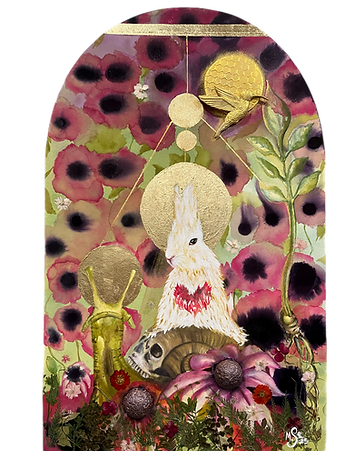
Drollery Hare, Poppies and Susans.
32 x 20 x .5 inches, 04/2025.
Painting Recipe: laked daffodil, indigo, logwood, madder root, oak gall, pokeberry, yellow cosmos, yellow onion skin, yellow yarrow, and white tempera on cold press watercolor paper mounted to wood panel.
Applied Materials: clay, a fused glass crown, and a cherrywood overlay frame. The work incorporates preserved botanical materials, a mycelium substrate grown as the cones of the cone flowers and gold leaf.
Description:
This painting celebrates spring and the turning wheel of life, with radiant divinity lines streaming from behind the hare like light breaking through a cloud. Its imagery borrows from the drolleries of medieval illuminated manuscripts, those playful, sometimes grotesque scenes that bloomed in the margins and borders of sacred texts. Among these curious illustrations, rabbits wage fierce battles, ride snails into combat, and brandish swords, tiny acts of absurdity and subversion tucked beside the holy word.
Folk:
Buddhist folklore: The hare who sacrificed himself. A Buddhist Jataka tale tells of a hare who encounters a hungry traveler who is actually the god Indra in disguise. The hare has no food to offer, so he sacrifices himself by leaping into a fire to feed the stranger. Moved by the hare's selflessness, Indra preserves his image on the moon. The story associates the hare with compassion, generosity, and the willingness to sacrifice oneself for another being. It transforms a small terrestrial animal into a celestial emblem of moral beauty.
Photograph: Environmental conditions:
Location:
39.18968 ° N
86.53430° W
Moon Phase: waxing crescent phase
Animal: Hare
Species: 21 species of hummingbirds are listed as endangered or critically endangered, with many others experiencing population declines due to habitat loss and climate change.
Represents: April
Luna Moths, Mushrooms and a Fox.
32 x 20 x .5 inches, 05/2025.
Painting Recipe: lac, laked indigo, logwood, madder root, oak gall, yellow cosmos, yellow onion skin, on cold press watercolor paper mounted to wood panel.
Applied Materials: clay, a fused glass crown, and a cherrywood overlay frame.
Description:
Clay-shaped May flowers crown the head of a sleeping fox, who lies nestled among foxfire mushrooms. In Japanese folk tradition, these glowing fungi are tied to kitsunebi (狐火), literally “fox-fire,” the ghostly lights said to flicker where foxes dream and wander.
Above them, a gold-leaf moon rises, circled by luna moths. They are both design and reminder: a quiet divinity moving through the sacred ecology that holds all life.
Folk: In Japanese mythology, the glowing light associated with accounts of foxfire (kitsune-bi or "fox flames") is said to be carried by magical foxes (kitsune).
Photograph: Environmental conditions:
Location:
39.13385° N,
86.49885° W
Moon Phase: Cresent
Animal: Fox
Species: The Sierra Nevada red fox is endangered. All red foxes belong to a single species (Vulpes vulpes).
Represents: May


The Indigo Four,
32 x 20 x .5 inches, 07/2026.
Painting Recipe: butterweed, indigo, yellow cosmos, yellow marigold, madder, & black eastern nightshade on watercolor paper mounted to wood panel.
Applied Materials: clay and gold leaf.
Description:
Artists have always kept dogs close: Kahlo’s xoloitzcuintli, Picasso’s Lump, Warhol’s Archie and Amos. The Indigo Four, named for the Indigo Child, honors the artist’s own four companions, studio mates who bring daily joy, painted here in play, in rest, and at attention. In the high middle ages symbolism mattered a great deal. Medieval bestiaries praised the dog’s loyalty, and the legend of St. Roch and his dog, along with the cult of Saint Guinefort (a dog venerated as a martyr in 13th-century France), shows how deeply dogs figured in religious imagination.
Folk: Canines—dogs, wolves, foxes, jackals, and other members of the dog family—appear in folklore across the world as guardians of the spirit world, loyal companions, tricksters, protectors of the vulnerable, guides to the afterlife, and symbols of instinct and transformation. Their stories often explore the relationship between humans and animals, the boundary between life and death, and the mysterious knowledge that animals seem to possess.
Photograph: Environmental conditions:
Location:
39.123688° N
86.538757° W
Moon Phase: Full Sun
Animal: Canine
Species: A canine refers to any member of the biological family Canidae.
Represents: July
Hatchling, Koi and Butterfly,
32 x 20 x .5 inches, 08/2026.
Painting Recipe: laked algae, lac, marigolds, oak gall and yellow cosmos on cold press watercolor paper mounted to wood panel.
Applied Materials: chalk, clay, fused-glass crown, cherrywood overlay frame, recycled ice cream lid turned observation disc, ethically foraged butterfly, preserved botanicals, and gold leaf.
App
Description: A newborn hatchling, surveys the small kingdom gathered around him: a crown of fused glass, a ring of pressed botanicals, a gleam of gold. The recycled lid becomes an observation disc, a quiet lens to view a preserved butterfly, a delicate guest in an unlikely scene. In the Amazon, butterflies and bees alight on the heads of river turtles and hatchlings and drink their tears, a practice called lachryphagy. Ecologists call the relationship commensalism: one creature is nourished while the other goes untouched. It is a small, tender story of fragility meeting fragility, framed in cherrywood.
Folk: In Aztec Culture: Hundreds of gathered butterflies represented the souls of fallen warriors or sacrificed heroes.
Photograph: Environmental conditions:
Location:
39.19514° N
86.34726° W
Moon Phase: Waning Crescent Moon
Animal: Aligator
Species: hatchlings or baby crocodiles belong to the order Crocodilia and the family Alligatoridae.
Represents: August


Luna Scharf - Diaphanous Dream,
32 x 20 x .5 inches., 09/2026.
Painting Recipe:
laked indigo, pokeberry dye, mica minerals, and white tempera, silver leaf on cold press watercolor paper mounted to wood panel.
Applied Materials: clay, fused-glass crown, cherrywood overlay frame.
Description:
The painting captures an intimate, playful encounter with the divine, offering a rare glimpse of the sabrewing hummingbird within its delicate, micro-endemic world. Splashes of silver illuminate the composition, while pokeberry pigments transition from fading hues into oxidized earth tones, revealing the natural evolution of color over time. This organic movement and vibrancy echo the hummingbird’s spirited energy, evoking the ephemeral beauty of a world that is both diaphanous and ecologically distinct.
Folk: In indigenous cultures across the Americas, the hummingbird symbolizes healing, joy, love, and sacred messaging that bridges the physical and spiritual worlds
Photograph: Environmental conditions:
Location:
39.12426° N
86.54326° W
Moon Phase: Wet Moon
Animal: Sabrewing Hummingbird
Species: “Sabrewing” refers not to a single species, but to a group of approximately ten large hummingbird species belonging to the genus Campylopterus within the family Trochilidae. The Sabrewing hummingbird is the rarest hummingbird in the world. It is listed as critically endangered and micro-endemic (restricted to a very tiny natural habitat).
Represents: September


The Black Cat Planet Parade, 32 x 20 x .5 inches, 10/2026.
Painting Recipe: laked daffodil, lac, marigolds, oak gall, yellow cosmos and white tempera on cold press watercolor paper mounted to wood panel.
Applied Materials: clay, fused-glass crown, cherrywood overlay frame. Bio plastic; feathers, butterfly wings, and frog using red algae and vegetable glycerin, mica minerals, silver and gold leaf.
Description:
The painting celebrates the season’s planetary parade, capturing a tender moment of comfort amid glowing amber orbs of color. Inspired by the symbolism of the High Middle Ages, black cats evoke mystery, intuition, concealed knowledge, and the threshold between visible and invisible worlds. Nestled deep within the heart of a water leaf, a chipmunk guards its untold secrets.
Folk: In parts of the UK and Japan, black cats symbolize prosperity, and finding one on your porch or in your house is thought to bring wealth and happiness.
Photograph: Environmental conditions:
Location:
39.16551° N
86.54735° W
Moon Phase: Solar Eclipse
Animal: Cat
Species: The domestic cat, scientifically known as Felis catus, is the primary species found in domestic ecosystems. They are obligate carnivores and have been domesticated for companionship and pest control, coexisting with humans for thousands of years.
Represents: October